Nagelsmann to Chelsea
- registacfc
- Apr 21, 2023
- 14 min read

What is minimum width? What is a box midfield? These are just two of the main concepts of Nagelsmann's teams, and in this article we are going to take a deeper look at these.
With talks of Julian Nagelsmann joining Chelsea heating up, I am going to be analysing some of Nagelsmann's tactics at previous clubs RB Leipzig and Bayern Munich and correlating how they could work for Chelsea.
By doing this, we can then assess which players Nagelsmann would like for his system and philosophy in this current Chelsea group , as well as analysing how he could line up for Chelsea come next season if he does end up in the dugout.
This analysis and data will be drawn from two 90 minute matches that I have coded myself, and then a further pool of pre coded games (that will be refereed to when used in the analysis).
Nagelsmann is known for being very tactically versatile and he likes to make tactical tweaks a lot. Therefore the formations and systems I have analysed here, are just two of the main systems Nagelsmann used at these clubs, and systems I could see him using at Chelsea. I will also touch on Nagelsmann's usage of a 3-4-3/3-4-1-2 as he has done this at times with both RB Leipzig and Bayern Munich.
The two games that I have coded and analysed for this article are, RB Leipzig vs VFL Wolfsburg in the 2019/20 season DFB- Pokal 2nd round. And Bayern Munich vs Union Berlin in the 2022/23 season in the Bundesliga. (All images taken from German Football YouTube channel streams of these two games) (https://www.youtube.com/@GermanFootball)
RB Leipzig under Nagelsmann:
When Nagelsmann joined RB Leipzig in 2019, expectations were already set high for this upcoming star-studded manager. Already being dubbed as the next Jose Mourinho (young breakthrough manager), Nagelsmann still had a lot to prove. Nagelsmann began his RB Leipzig tenure using a 3-4-3 formation, however the formation and system we will be focusing on is Nagelsmann's famous 4-2-2-2 positional styled system at Leipzig.
(Figure 1)
The shape as seen in figure 1 looked something like this at the start of games. However Nagelsmann soon found that by having Timo Werner drift wide occupying maximum width areas of the pitch, it allowed Forsberg more time and space in the half spaces on the inside left. This was effective and got the best out of both of these players skill sets.
In the game against Wolfsburg, Nagelsmann started in this shape which saw RB Leipzig run away with a 6-1 win, where they dominated the game and looked dangerous throughout. As mentioned, Werner was drifting out to occupy the maximum width area of the pitch out on the left side, with Forsberg drifting into the inside left half spaces. This allowed Leipzig to break with pace, as Werner has blistering speed and by having him wider it allows him to be an outlet when winning back possession and quickly counter attacking.

(Figure 2)
In this example (figure 2) Werner is the widest player on this left flank. This allows Demme to put the ball into this wide left channel where the Leipzig forwards are breaking from, and allow Werner to use his pace on the counter attack to get Leipzig up the pitch and into a dangerous area quickly, in as few passes as possible. Nagelsmann wants his players to find these open pockets of space when out of possession, so that when possession is won they can quickly break and have the advantage over the opposition.
Nagelsmann is known for his high pressing intensity, as he wants his teams to play high up the pitch in the opposition half. Nagelsmann said his philosophy is "control the game by winning the ball high up the pitch and changing the tempo in possession".

(Figure 3)
As you can see in figure 3, Leipzig are pressing high in the opposition defensive third, they have swarmed the ball and have effectively trapped Wolfsburg in their own half. Leipzig have created a 5 man press surrounding the ball in a narrow central area of the pitch. This eventually leads to Leipzig winning the ball in the opposition half and being able to turn defence to attack which correlates to how Nagelsmann described his philosophy.
Nagelsmann uses a concept known as "minimum width", this is where the furthest wide player on each side is wider than the opposition fullback/winger (whoever is there widest defending player at the time), but not out on the touchline.

(Figure 4)
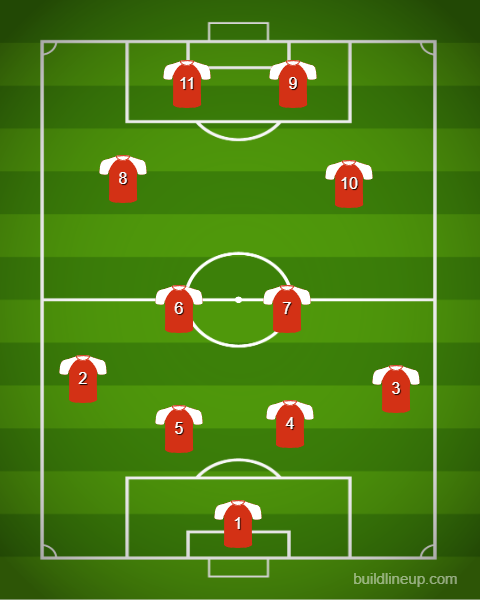
In figure 4, this image shows the concept of minimum width. The wide players for the blue team (numbers 10 and 11) are providing width outside of the opposition fullbacks whilst still being inside the central zones of the pitch. This now means players are closer together, and the "wide" players are closer to the goal when receiving the ball and can be more dangerous and direct towards the goal.
By having the players more narrow and closer together, this also fits with Nagelsmann's philosophy where he wants his team to win the ball back high up the pitch and change the tempo of the game. As his players are closer together in this minimum width format, they can quickly swarm and counter press the opposition as soon as they lose possession of the ball (as shown in figure 3). This can then lead to Nagelsmann's team winning the ball in dangerous areas and being able to turn defence to attack in minimal touches/passes.

(Figure 5)
One other key factor of Nagelsmann's Leipzig team was blindside runs into the half spaces. By having a forward like Timo Werner who likes to drift slightly wider and attack fullbacks 1v1 with his pace, it draws the attention of the defenders pulling them away from the central half space areas.
As you can see in the example in figure 5, Werner has drifted from a striker position to the wider right position in a "minimum width" concept. This has allowed for Sabitzer to make a blindside run into the space left by Timo Werner leaving him in a goal scoring position. This possession ended in a Sabitzer goal.
These rotations and runs were a staple of Nagelsmann's Leipzig team and this fit the personnel he had at the club, with the likes of Timo Werner drifting wider and having inside forwards such as Forsberg and Sabitzer who loved to play in these half spaces provided.
Bayern Munich under Nagelsmann:
Now to move on to Nagelsmann's "dream" job, Bayern Munich. Nagelsmann was a boyhood Bayern Munich fan and many believe this job was what Nagelsmann considered his "end goal" and the pinnacle of his career. After leading RB Leipzig to a 2nd place finish, and the Semi Final of the Champions league, Nagelsmann was approached with an offer he could not refuse. So Nagelsmann took over as Bayern Munich head coach on April 27th 2021. This was for a world record fee at the time for a manager at around £21.7 million pounds.

(Figure 6)
Figure 6 is the team Nagelsmann won the DFL- Supercup with, beating Borussia Dortmund 3-1. The general set up is a 4-2-3-1, which is a very generic football formation. However Julian Nagelsmann being a bit of a tinkerman means this wasn't the average 4-2-3-1 system. Lets take a look at some principles that made Nagelsmann's Bayern Munich 4-2-3-1 different and effective.
The identity of Nagelsmann's Bayern Munich side consisted of, minimum width (similar to RB Leipzig), high press + high intensity, and the rotations in possession to create a box midfield. These were 3 key factors of Nagelsmann's Bayern Munich that saw them go on to win the Bundesliga in his first season in charge, finishing on 77 points with 24 wins, 5 draws and 5 losses.
Lets firstly touch on Nagelsmann's use of the box midfield and the rotations to create it.

(Figure 7)
As you can see in figure 7, Davies (number 3) has pushed all the way up and is providing width as a winger. This allows Musiala (who starts on the left side of the 3 behind the striker) to drop more centrally into the half spaces creating the box midfield with Kimmich, Goretska and Muller.
So what advantages does the box midfield offer? The obvious advantage of the box midfield is the numerical superiority in the centre of the pitch. By creating this box midfield consisting of 4 central midfielders, it allows the team to build up with an overload in central areas to break down the opposition press and retain possession.
The other advantage that can be created when using the box midfield is the ability for one of the further central midfielders in the box (in this case number 7 and number 10) to break off from the box midfield and create space in behind the line of pressure from the opposition team. This suits the likes of Muller and Musiala as they are both excellent at receiving the ball in the half space and can create from there, which allows Nagelsmann to get the best out of both of these midfielders by deploying the box midfield in his system.

(Figure 8)
Here is an example of how the rotations when creating the box midfield (Davies going into the left wing position providing the width) creates space inside for Musiala. By Davies drawing the opposition defenders wide as they know his capabilities to drive to the by-line and cross the ball, it allows Musiala to pick up a very dangerous area inside the 18 yard box half space. This is a high output area for both of Bayern Munich's attacking midfielders in Musiala and Muller who like to operate in and around zone 14.
Nagelsmann likes to find his creative players in these high output positions on the field. This is one of the reasons Nagelsmann makes the rotations in possession that he does, in order for these two attacking midfielders to find these pockets of space where they can be at their most dangerous and excel.
Another key trait of Nagelsmann's Bayern Munich team is again centred around the two central midfielders at the top of the box midfield. This time we are talking about blindside runs made from these midfielders across the box into spaces left between a centre back and a fullback.

(Figure 9)
Here is an example of Musiala running into a space left by the opposition centre back and fullback as they are occupied by Muller towards the right side of the pitch. These runs from deep allow you to stretch the opposition defence by getting behind their final line and into dangerous areas. Another aspect of these runs is the idea that even if the pass is not played, the run made will cause rotations in the defensive line which can then free up space for the other attackers.
In this example it is Musiala making a run from the inside left channel across the box. If this pass was not played then the position Musiala has just ran from can now be occupied by another player such as Davies coming inside from the left wing. This can cause the opposition to scramble out of position leaving gaps to be exploited by the forwards.

(Figure 10)
Here is another example, this time Thomas Muller making the same run across the box into the space behind the centre back and fullback on the right side of the pitch. In this case the ball does end up being played into that space, and Muller is able to craft a shot on goal from this position. However if the ball was not played, the other centre back who follows Muller into that space leaves a massive gap in the centre of the field which can then be occupied by Musiala and Davies instead.
By instructing these runs, Nagelsmann is aiming to force defensive line rotations that are unnatural. This allows his teams to be more free flowing going forwards, as they are constantly moving the ball and moving the opposition into unnatural areas of the field.
Bayern Munich under Nagelsmann played in the 4-2-3-1, however they adopted many of the principles that we also discussed during the Leipzig analysis. Minimum width, high pressing + high intensity, a box midfield and blindside runs to stretch the opposition. These are four KEY factors of Nagelsmann's play style.
Nagelsmann at Chelsea?:
Now that we have an understanding of Nagelsmann's tactical ideas and how he likes to set his teams up. Lets analyse how he could implement these approaches at Chelsea with the current playing personnel at his disposal, and which individuals could flourish playing under Julian Nagelsmann.
The first thing to note is Nagelsmann has supposedly suggested Chelsea need to sign a Striker, a Defensive midfielder and a Goalkeeper to add to the current squad. For this article, I have placed theoretical Chelsea transfers for these positions into the team based off of Nagelsmann's style, and also links to Chelsea in recent weeks. Those transfers consist of Victor Osimhen, Romeo Lavia and David Raya.

(Figure 11)
Here in figure 11 is the first concept system as to how Nagelsmann could set up at Chelsea. There is a number of ways Nagelsmann could adopt this similar Bayern Munich set up at Chelsea, one of which being Chilwell as the Davies like for like, allowing Chilwell to play higher up where he is most effective offering the width.
However with Nagelsmann having the option of Mykhalio Mudryk, I could see him using Mudryk very much like he used Timo Werner with Leipzig. By having Mudryk drift out to the left to offer the team width and pace on the flank, it would allow the two attacking midfielders at the top of the box midfield to occupy the positions similar to Musiala and Muller. This is where the ability of Nkunku and Joao Felix (should he stay at the club) could be best utilised in these tight pockets around zone 14.
Similar to Werner, Mykhalio Mudryk offers blistering pace which can stretch opposition defences, leaving gaps in the half spaces for the attacking mids. This is why Mudryk could be pivotal for Nagelsmann, as he had Werner at Leipzig and Davies at Bayern Munich to offer this threat which became a staple of how he created chances and spaces for his attackers. The ability of Mudryk to go 1v1 with the opposition fullback and put dangerous crosses into the box will leave the opposition defenders with the choice of doubling up on Mudryk to pressure him, which would leave the space inside for the attacking midfielders to operate. The other option is they can allow Mudryk to go 1v1 with the fullback which would create opportunities from Mudryk getting to the by-line and putting dangerous balls into the box for the fleet of attackers waiting. Either way, this would make Mudryk pivotal in the way Chelsea look to attack and generate chances, even when he is not directly involved on the ball. One thing to note is that if Mudryk is used in this way at Chelsea, I believe Nagelsmann would prefer his left back to be slightly more inverted and be able to play as that left centre back when in possession, therefore either Maatsen or Cucurella could be used in this position.
Another player I could see flourishing under Julian Nagelsmann and being pivotal for his system is Mason Mount (should he sign a contract renewal). Mason Mount has the intensity and pressing capabilities that Nagelsmann loves to have in his side. Mount is also excellent in the half spaces at turning quickly and making the right decision when playing out of those positions. I think a key factor on whether Mason Mount signs a new deal would be down to Nagelsmann wanting to keep Mount as a key player for his side. Even in a poor season by Mason Mount's standards he has still managed to post 1.82 tackles per 90, 1.44 dribblers challenged per 90 and 0.69 dribblers tackled per 90 (stats from Fbref), which shows Mount's willingness to press and recover the ball in high areas of the pitch (which Nagelsmann wants). Referring back to a quote used earlier where Nagelsmann described his philosophy as "control the game by winning the ball high up the pitch and changing the tempo in possession", even those critical of Mason Mount, one thing that is clear by his numbers and by watching him play is his ability to press the opposition and win the ball back high up the pitch.

(Figure 12- Image taken from SPORTBILD)
Someone else who will benefit from the arrival of Nagelsmann is Christopher Nkunku who will be arriving in the summer from RB Leipzig. Nagelsmann signed the Frenchman from PSG at the age of 21 for a fee of around £11.5 million. Now Nagelsmann could be reunited with Nkunku at Chelsea as they have agreed a summer deal for Christopher Nkunku at a fee of around £52 million (exact fee yet to be announced).
When at Leipzig Nkunku was often played as a second striker playing off of Poulson (a natural number 9), he also played in one of the two attacking midfield positions that Sabitzer and Forsberg occupied in his first season at the club (2019/20). Nkunku's ability on the ball, and ability to pick up spaces behind the lines of press is a key factor as to why Nkunku could be extremely important for Nagelsmann at Chelsea should he deploy a similar system that he did at Bayern Munich. Nkunku could be used as the Thomas Muller or Musiala type player for Chelsea in this attacking midfield position where he can join the box midfield when building up play, but also drift off into half spaces behind the lines and create opportunities from these areas, much like Thomas Muller and Jamal Musiala did.
Nkunku has produced a whopping 0.49 non penalty x/G per 90 which is in the top 98% of players in his position, as well as creating 3.88 Shot- Creating actions per 90 (stats from Fbref). Nkunku could be very pivotal for Nagelsmann and become Chelsea's real creative hub going forwards.

(Figure 13)
Here is the provisional squad I have put together for Chelsea going into the 2023/24 season. This could of course be very different with certain players leaving and certain other additions, however this is just a rough guideline of players I believe Nagelsmann would want at the club to play the way he does.
A few other names that haven't been mentioned yet in regards to their possible impact for Nagelsmann are, Enzo Fernandez who I believe will be the controller of this team, much like Kimmich was for Bayern and by putting a Lavia type player (other options include Rice and Ugarte) next to him, it will allow him to control the game on the ball and not have as much defensive responsibility (whilst still using his ability to win duels and stop opposition counter attacks).
Levi Colwill. Colwill's ability to play passes between the pressing lines, into the midfielders and beat the opposition press is something Nagelsmann will really appreciate. At both RB Leipzig and Bayern Munich, Nagelsmann loved Dayot Upamecano as his ball playing central defender. He liked Upamecano's ability on the ball to beat the line of press and play through the pressure, Upamecano is in the top 90+ percentile (stats from Fbref) for passes attempted (85.90 per 90), pass completion (90.7% per 90) and most importantly progressive passes (6.19 per 90).
Levi Colwill is of a similar profile in terms of his ball playing ability. Colwill is currently registering 82.78 passes attempted per 90, 88.5% pass completion per 90 and 4.43 progressive passes per 90. This profile of defender is important for Julian Nagelsmann as he likes to progress the ball from the back, and when possible play midfield splitting passes from his central defender. Colwill is perfectly suited to this role for Nagelsmann and I can see him taking a real liking to Levi.
One final player to mention is Kai Havertz. A player who's Chelsea career has been defined on a big moment, scoring the Champions league winning goal in 2021. Kai Havertz has suffered from his own versatility since being at Chelsea, being played in a number of different positions such as a striker, attacking midfielder, a winger and even in a midfield three.
I could see Nagelsmann getting the best out of Havertz in one of the attacking midfield positions he uses. Often Havertz has been refereed to as the perfect Muller replacement at Bayern Munich. I can see Nagelsmann using Havertz in the Thomas Muller role for Chelsea which could finally see Kai Havertz live up to his price tag.

(Figure 14)
One final thing to discuss is the possibility of Nagelsmann using a three at the back formation, as he did at times with both RB Leipzig and Bayern Munich.
Again the current playing personnel at Chelsea (once acquiring the three positions highlighted by Nagelsmann) fits this system very well. The ability to play two inside forwards such as Nkunku and Felix which could also be Havertz, Sterling or Mount would suit their profiles (maybe not so much Sterling who is naturally a winger), while allowing the wingbacks Reece James and Ben Chilwell to provide the width going forwards, still creating a box midfield as previously spoken about.
Conclusion:
Overall, I believe with a few incomings, and a lot of outgoings, Julian Nagelsmann has a very strong squad to work with and implement his ideas. The player profiles he has available fit the way Nagelsmann has generally wanted to play throughout his short managerial career so far. I personally believe Nagelsmann could get the best out of this Chelsea project and begin the upwards trajectory the clubs desperately needs.


Comments