Pochettino, The New Chelsea Head Coach.
- registacfc
- Apr 26, 2023
- 11 min read

With Mauricio Pochettino taking over the post as the new Chelsea head coach being imminent. I am going to do a detailed analysis of Pochettino at his previous clubs, what individuals he has worked well with, and how we can expect all of this to tie together at Chelsea.
Pochettino started out his managerial career with Espanyol in 2009 tasked with saving them from relegation. Managing to do this, Pochettino was kept as the Espanyol manager for a further two season prior to his induction season for Espanyol. In January of 2013, Southampton came knocking for Pochettino to replace Nigel Adkins as their head coach. At Southampton Pochettino had some excellent results in his first half season joining the club including wins against, Manchester City, Liverpool and Chelsea. In his first full season at the club (2013/14 season) Pochettino led Southampton to an 8th placed finish which was their highest league finish since 2002/03.
However it was the next two jobs that we are going to be taking a deeper look into for Pochettino, and how these two jobs shape the landscape for when he joins Chelsea.
For this article I have coded games from Pochettino's time at Tottenham and PSG. These games are Tottenham vs Manchester United 2017/18 league cup semi final ( https://www.youtube.com/watch?v=YYHmFs1BY2E&t=2081s ), PSG vs Metz (League game 2021) and PSG vs Marseille (League game 2021). Both of the PSG games coming from ( https://www.youtube.com/@Ligue1official ).
Pochettino at Tottenham:

(Figure 1)
In figure 1 is the first team Pochettino fielded in his first Premier league game for Tottenham in a 1-0 win away against West Ham. The 4-2-3-1 is a formation we will continue to refer to throughout this article, as Pochettino in his time at Tottenham and PSG used many variants of his 4-2-3-1 formation with different structures and fluidity.
Pochettino started in what looked like a 4-2-3-1, however he was known for having formationally fluid tactics, where certain rotations and movements were made in phases of the game to give different tactical structures within the 90 minutes. In his Tottenham days this was a 4-2-3-1 which could rotate into a 3-4-2-1 in attack.

(Figure 2)
As you can see this is a visual example of how Pochettino's Tottenham team rotated into a 3-4-2-1 when going forwards. Eric Dier would take up the role as a "Halfback" where he would drop between the two centre backs and offer build up options. The two fullbacks would push high and wide to offer width, whilst Eriksen would come more central to pick up the ball and be the creative hub for this Spurs side. This would then leave a front 3 of Son, Alli and Kane which was very dynamic and able to rotate between them, allowing different combinations of passes and runs in behind.
Lets firstly touch on the role Eric Dier was given for Tottenham and his importance under Pochettino.
In Tottenham's three most impressive season's under Pochettino there was a direct correlation between the success of Tottenham and the involvement and usage of Eric Dier playing in this Halfback role. In 2015/16 Dier played 3,263 minutes when they finished 3rd in the league, then in 2016/17 Dier played 3,043 minutes and Tottenham finished 2nd in the league, and finally in 2017/18 Dier played 2,824 minutes and Tottenham finished 3rd in the league.
Then in following season Dier began to average less minutes, 2018/19 and 2019/20 Dier only produced a combined 2,850 minutes across the two seasons, and both of these seasons ended in Spurs finishing 4th and 6th.
So what made Dier so important for Pochettino? His ability to play in the defensive midfield role but also his versatility to play as a third centre back made him the perfect fit for Pochettino's "halfback" role. Dier would protect the defence in transitions being the deepest midfielder, but also drop between the two centre backs when necessary and help building out from the back.

(Figure 3)
As you can see in figure 3, Dier is the deepest player in the Tottenham build up pattern, dropping in to create a back three. Pochettino likes his centre backs to be very good on the ball, allowing them to progress play both laterally and vertically. A staple of this Tottenham team was the three centre backs ability to play long vertical balls and completely miss the midfield when possible to set Tottenham on quick attacking breaks. They would allow teams to press onto them and then find ways to beat the press and progress the ball quickly through the lines.

(Figure 4 - from Sky Sports)
Another key ingredient to Pochettino's success at Tottenham was how he implemented his overall philosophy which essentially consisted of being a hard working and high intensity team. As you can see in figure 4, Pochettino's team are largely known for covering A LOT of distance. As you can see Pochettino managed four of the eight teams in the graphic shown in figure 4 (3 being his Tottenham teams and 1 being his Southampton team), these being the highest distance covered teams since 2013/14 at the time of the graphic being shown on Sky Sports (2020).
Pochettino wants his teams to be extremely fit, and be able to cover a lot of area, winning their personal duels all over the pitch. He wants to win the ball back in advantageous positions on the pitch and turn defence to attack with quick direct movements when possible.
Pochettino said on Monday night football on Sky Sports " When I joined Tottenham they had a 33 man squad, they wanted to create an identity and change the path they were building until there". Pochettino implemented his style at Tottenham and changed the identity of the club as you can see here with 3 consecutive seasons of distance per game covered being + 114.4km per game.

(Figure 5)
The last thing I am going to highlight for Pochettino's Tottenham team is the way Eriksen occupies space and his significance for Pochettino.
In figure 5 Eriksen is seen in between the two retreating lines of Manchester United defenders. This is where Eriksen would drift inside and operate as Pochettino gave Eriksen this license to roam and create in the pockets of space left by opposition defenders. As Eriksen would drift central the width on the right would be provided by the fullback (Walker or Trippier) pushing high and wide. This allowed Eriksen to find these spaces where he could hurt the opposition from central areas and create chances. Eriksen was Tottenham's main creator picking up 38 assists over the seasons 2015/16, 2016/17 and 2017/18 (The three seasons Tottenham achieved top 3 Premier league finishes).
Pochettino at PSG:
At PSG the story was very different for Pochettino. Rather than transforming an identity, using youth players and developing the overall squad. The task at hand with PSG was much less complex. Win trophies and compete for the highest honour, an illusive Champions league title that PSG have never won before. Pochettino was tasked with leading PSG to instant success and using their incredibility talented (and expensive) squad.

(Figure 6)
Similar to his time at Tottenham, Pochettino used a formationally fluid tactic where the team would start in a 4-2-3-1 but rotate into different structures such as the 3-4-2-1 and even a 4-3-3 with different personnel.
Of course something to note is that with PSG Pochettino had three WORLD CLASS forwards that had to be playing every week in Messi, Mbappe and Neymar. This made it slightly harder for Pochettino to always implement exactly what he wanted in comparison to his Tottenham days.
Figure 6 shows the 4-2-3-1 formation that PSG would deploy that could transition into the same 3-4-2-1 formation that Pochettino used with Spurs. This 3-4-2-1 would be formed slightly different than it was with Tottenham as the positional transitions didn't really involve a half back, instead the number 6 would still play in the defensive midfield position to cover and win back the ball in transition, but Verratti would play as that controlling midfielder who really allowed PSG to tick in that engine room. The ability for Verratti to drop deep and get on the ball allowed PSG to progress through the lines of play quickly using Verratti's passing ability and footballing IQ. The rest of the 3-4-2-1 variant was similar as Messi became the free floating playmaker and a front 3 of Neymar, Di Maria and Mbappe was formed with the two fullbacks pushing high and wide.

(Figure 7)
As you can see in figure 7, the spacing between Neymar, Messi and Mbappe is extremely tight and this was something we saw often for PSG in attacking positions. Having three attackers of this ability allows the attack to function in very tight areas of the pitch. By creating this close triangle, it creates space out wide for the fullbacks to engage and also drags the defenders closer which then leaves space in behind after a quick passing sequence.
In this example in figure 7, the quick play in the central area between Messi, Verratti and Mbappe allows Neymar the space in behind to make the run and get in on goal. This scenario ended with a Neymar goal.

(Figure 8)
Here is another example in figure 8. Messi, Mbappe and Neymar are all in an extremely tight triangle in the middle of the pitch. This has drawn all of the back fours attention, allowing Hakimi to push high and wide and get into a really dangerous area going into the 18 yard box.

(Figure 9)
Here is one more example of this tight triangle in the middle of the pitch. This example is from PSG pressing high up in the opposition half and winning the ball back. The way PSG press high up the pitch and narrow with the forwards pressing central areas, means that when they do win the ball back they are in central and dangerous positions to turn defence to attack with minimal passes and movements.
(Figure 10)
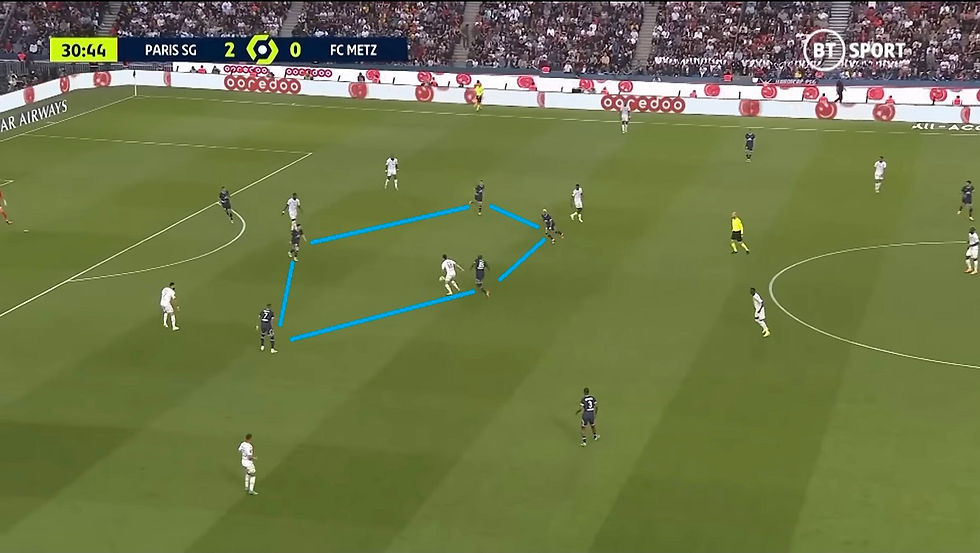
Here is an example of this high narrow press mentioned from figure 9. In figure 10, PSG surround the midfielder with this pressing pentagon as we will refer to it. The fullbacks are covering the wide outlet passes whilst the central midfielders and forwards are pressuring the opposition midfield and defenders in the central areas of the pitch. As mentioned above this allows PSG to turn defence to attack quickly when recovering the ball in these areas of the pitch as they are obviously closer to goal, and therefore have a more direct route to creating a high output chance.
So as I mentioned there was many similarities between the systems Pochettino wanted to implement at both Tottenham and PSG. Pressing high, being formationally fluid and having ball playing defenders were massive factors for both of these teams Pochettino managed. The key difference was how Pochettino used his Tottenham attack in rotation and how he used this central triangle in attack for PSG to utilise the ability of his world class forwards at PSG. As also mentioned, there was differences in the ways both Tottenham and PSG were formationally fluid and differences with the rotations made at each club e.g. Dier as a
"halfback" for Tottenham.
Pochettino at Chelsea:
And now here is where things get interesting. What can we expect to see from Pochettino at Chelsea? Which players will benefit from Pochettino's arrival and his tactics? and how will certain personnel fit into the system Pochettino could play at Chelsea? Lets take a look.

(Figure 11)
In figure 11, I have put a concept of how this Chelsea team could look next season under Pochettino. It is important to note that this is just a CONCEPT. I believe a player like Mount for example could be pivotal for Pochettino in a similar position to where Felix is playing in the figure 11 graphic. With the squad Chelsea have Pochettino would have a big squad to choose from and pick his favourites for each of these roles. Therefore the above graphic is more so to visualise the roles Pochettino would have for certain personnel at Chelsea and now we are going to talk about individuals and how they could fit into this. This included the different signings mentioned on these examples, as I also believe someone like Toney could be a better fit for Pochettino as the focal point, and the Goalkeeper could really be anyone next season for Chelsea.
So I believe Pochettino will play his 4-2-3-1 system with Chelsea which has the ability to transition into a 3-4-2-1 during phases of play. Similar play styles would be adopted as at Tottenham and PSG where the fullbacks push high, and the other forwards invert more central as inside forward/attacking midfielders.
One player that will really flourish under Pochettino in my opinion is Mykhalio Mudryk. Mudryk is still an extremely young and raw talent who has a lot of potential. However he is really waiting to be moulded into the world beater he could be, with his blistering pace and the right coaching we could see Mudryk become Chelsea's superstar forward. Mudryk would be best utilised as a threat in behind, being able to link up with quick passing sequences and then stretch the defence by running in behind which is comparable to both Son at Tottenham and Mbappe at PSG. With the coaching from Pochettino to perfect this role, and the athleticism that Mudryk already has, this really could be a recipe for success.
Another player I believe will largely benefit from the arrival of Pochettino is young centre back, Levi Colwill. The 20 year old english towering centre back is of course still extremely young, however he is already touted as one of the best defensive young talents in europe. Being coveted by many top clubs already, Chelsea do not want to lose Levi.
Colwill's ability on the ball is something Pochettino will adore, as we mentioned previously Pochettino loves his central defenders to be good with the ball at their feet, allowing them to progress play both vertically, as well as horizontally. Colwill's skillset will fit Pochettino's brand of football perfectly as he is a very good ball playing defender, who is physically strong and reliable in defensive transitions.

(Figure 12 - from Sky Sports)
The last player I am going to speak about in terms of positive outcomes of Pochettino's arrival is Mason Mount.
Mason Mount is currently a hot topic at Chelsea, with his contract renewal talks up in the air. However many have expressed that Mason Mount is admired by Pochettino and he would be part of his plans. As we have said in regards to Pochettino's philosophy, he wants his team to press high and play with a high intensity and this is something Mount delivers. Mount suits Pochettino's territorial dominance brand and would very much lead the press in narrow areas of the field for Chelsea. This could see Mount used in the Eriksen role from Pochettino's Tottenham days. Mount's ability to press high out of possession, but to also get on the ball in the half spaces would allow Chelsea to function extremely well with Mount playing this role. It remains to be seen whether Mason Mount will sign a contract extension, however if he does he can certainly offer intensity and goals to the team.
Of course there are many other players I believe could benefit from the arrival of Pochettino such as Carney Chukwuemeka, Noni Madueke, Christopher Nkunku (perhaps occupying that Dele Alli role, and Kai Havertz (who could also occupy that Dele Alli role possibly). Enzo Fernandez, a fellow Argentine could also be happy with the arrival of Pochettino with his track record of progressing youth talents and Pochettino could regard Enzo Fernandez as his Verrati type controller for Chelsea.
My overall thoughts on the appointment:
So in conclusion, my thoughts on this appointment are optimistic with a hint of caution. I believe Pochettino suits the group of players and identity we are trying to build, however we have to be cautious as things could get rocky very quickly if Pochettino did not get off to a good start. His Spurs past could haunt him in this Chelsea job and it is pivotal he gets off to a good start at Chelsea to remove the stigma of his Tottenham past lingering over him at SW6.
As I mentioned earlier in the Tottenham analysis, the quote Pochettino said on Monday night football on Sky Sports " When I joined Tottenham they had a 33 man squad, they wanted to create an identity and change the path they were building until there" really stood out to me. This is extremely comparable to the situation Chelsea are currently in, and the young squad we have is really ready to be moulded into whatever the new manager see's fit. This is why I say Pochettino is well suited to this group and project Chelsea are currently building, as he can come in and put his print on this group as he did with Tottenham. Hopefully he can bring more success to Chelsea than he did with Tottenham as he will have a much larger backing from the board, as well as the talent he has at Chelsea being superior to what he inherited at Tottenham when joining in 2014.
I believe this appointment could go either way, however I am going to back Pochettino from the day he joins and hopefully the positives I have outlined here today can come to fruition, and Chelsea can return to challenging for major honours as soon as possible.


Comments